
Lion’s mane (Hericium erinaceus) does not look like most mushrooms. There is no cap and there are no gills. Instead it forms a white, rounded mass of soft, hanging spines, closer to a frozen waterfall than a button mushroom.
It is also one of the most rewarding species to grow at home. Lion’s mane fruits readily indoors on supplemented hardwood sawdust, it tends to pin early, and a single block can give two or three harvests. The catch is that it behaves differently from oyster or shiitake at almost every stage, and most failed grows come from treating it like those species.
This guide covers how to grow lion’s mane from liquid culture to harvest, with the methods we use on our own farm and the mistakes we see most often.
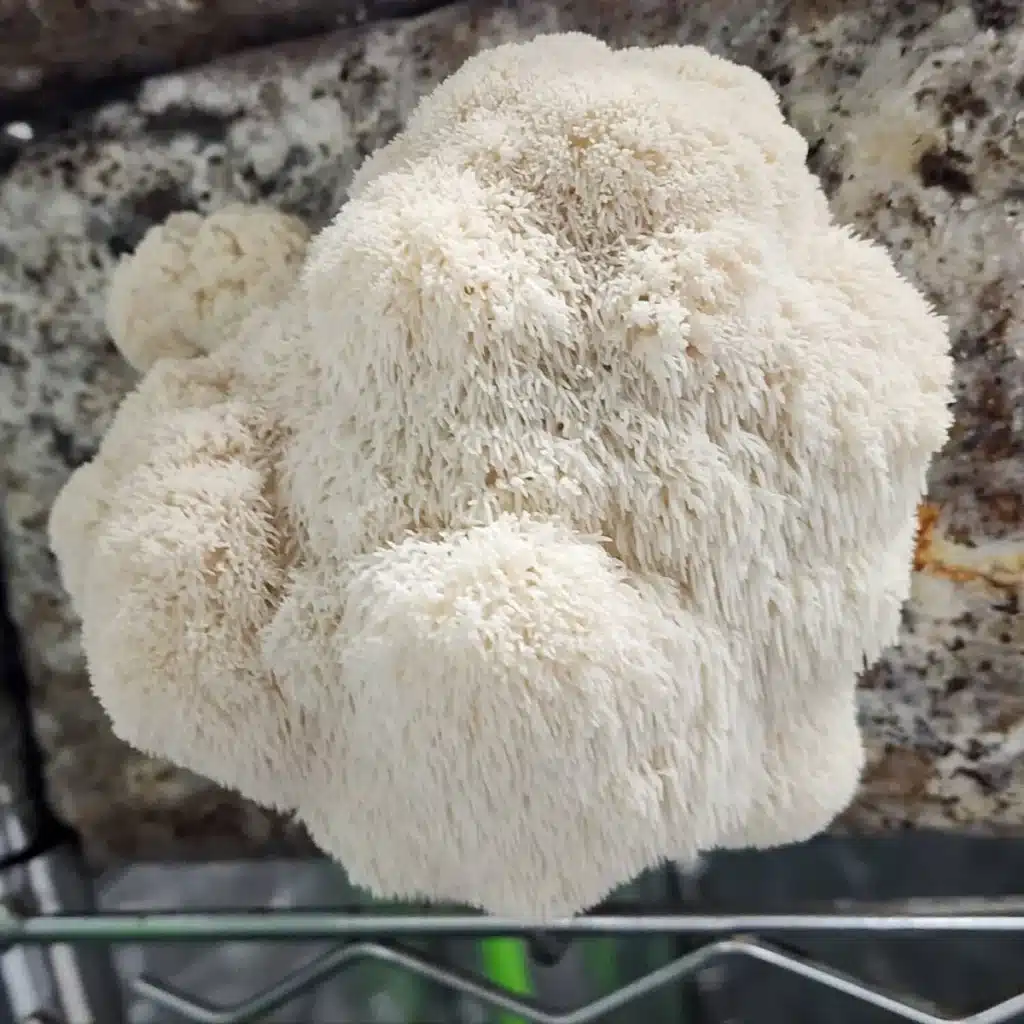
Lion’s mane at a glance
| Species | Hericium erinaceus |
| Type | Wood-decomposing tooth fungus |
| Best substrate | Master’s Mix (50/50 hardwood and soy hulls) |
| Colonization temperature | 70–75°F (21–24°C) |
| Fruiting temperature | 60–70°F (16–21°C) |
| Fruiting humidity | 85–95% RH |
| Fresh air | High; keep CO₂ low |
| Light | Indirect, about 12 hours a day |
| Time to first harvest | About 6–8 weeks from inoculating grain |
| Flushes | Usually 2–3 |
Where does lion’s mane grow in the wild?
In nature, lion’s mane is a hardwood decomposer. It fruits from wounds and scars on living trees and from standing dead trunks and fallen logs, often high enough on the trunk that people walk right past it.
In North America it is most often found on oak, beech, maple and walnut, typically from late summer through fall. It also occurs across Europe and Asia, where it has a long history as both food and traditional medicine.
A few close relatives share its habitat and its spines. Bear’s head tooth (Hericium americanum) and comb tooth (Hericium coralloides) grow as branched clusters, and Hericium abietis grows on conifers in the West. Lion’s mane is the one that forms a single, unbranched clump of long spines. As with any wild mushroom, confirm the identification before eating it.
That ecology explains what it needs in cultivation: wood, steady moisture and plenty of fresh air.
Can you grow lion’s mane at home?
Yes. Lion’s mane is one of the better species for indoor growers. It fruits well in a small space, such as a shelf with a humidity tent, a shotgun fruiting chamber or a small grow tent, and it does not need a dedicated grow room.
What it does need is the right substrate. Lion’s mane is a wood lover. Coir- and manure-based mixes such as CVG are designed for other species and will not support a good lion’s mane crop. Plan on a hardwood-based substrate such as Master’s Mix.
What you’ll need
- Lion’s mane culture: a liquid culture syringe or a clean agar plate. Our Lion’s Mane Liquid Culture is a reliable starting point.
- Grain for spawn: rye, oats, millet or wheat, in 3–4 lb filter-patch bags (or quart jars for small runs).
- Master’s Mix: a 50/50 blend of hardwood fuel pellets and soy hull pellets.
- Filter-patch grow bags and an impulse sealer.
- A pressure cooker or autoclave that holds 15 PSI.
- A clean workspace: a still air box or a flow hood.
- A fruiting space where you can hold humidity and exchange air.
How to grow lion’s mane, step by step
1. Start with a clean culture
Everything downstream depends on the culture. A weak or contaminated culture shows up weeks later as a stalled or green block, after all the work is done. Start from a trusted liquid culture or a clean agar plate.
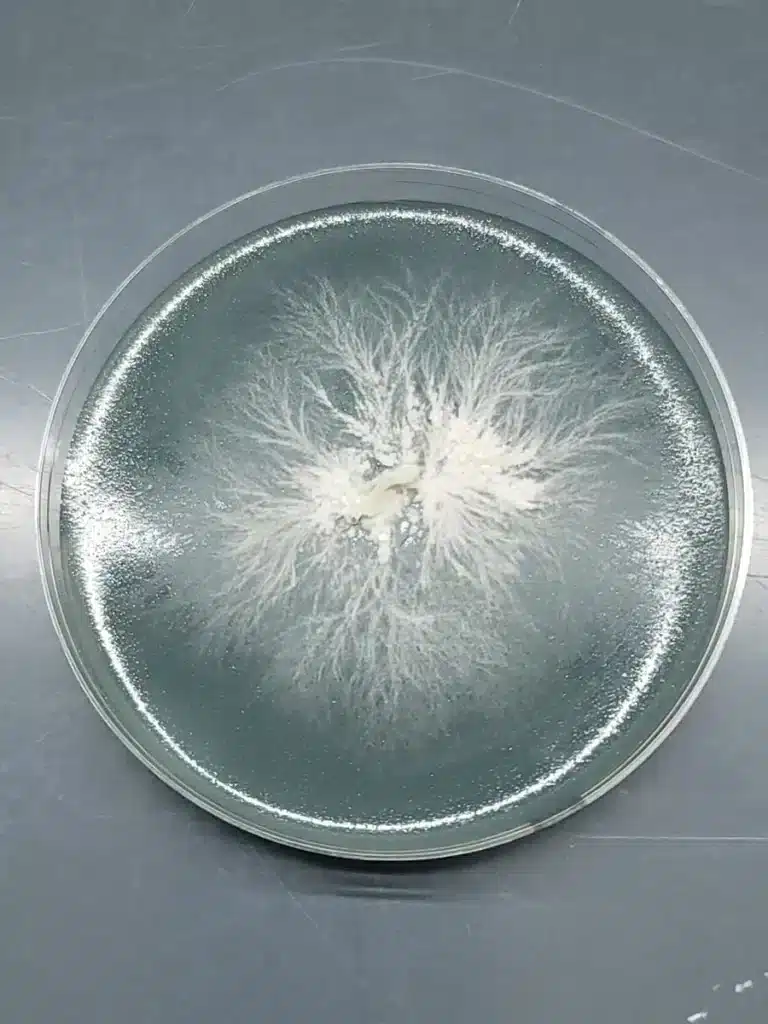
If you work on agar, expect lion’s mane to look thin and fine on the plate compared with oyster. That is normal for this species, not a sign of a weak culture.
2. Make grain spawn
Hydrate your grain and load it into filter-patch bags of 3–4 lb each. Sterilize at 15 PSI for 2.5 hours. That is the time it takes to fully sterilize a full load; on our farm we run 30 lb or more of grain per cycle. The 90-minute cycles you often see online are meant for quart jars, which hold far less material. Do not apply a jar cycle to bags.
Once the bags have cooled, inoculate each 3 lb bag with about 5 cc of liquid culture, working in front of a flow hood or inside a still air box. Incubate at 70–75°F. Lion’s mane typically colonizes grain in about 10–14 days. Break up and shake the bags at around 30% colonization to spread the growth.
3. Prepare the fruiting substrate
Lion’s mane grows best on Master’s Mix: a 50/50 blend of hardwood fuel pellets and soy hull pellets. It is the substrate we make and use on our own farm, and it gives lion’s mane the wood base and nutrition it needs for dense, heavy fruit.
Hydrate to field capacity, about 60% moisture: a firmly squeezed handful should release only a few drops. Fill filter-patch bags and sterilize at 15 PSI for about 2.5 hours. Supplemented sawdust must be fully sterilized rather than pasteurized, because the added nutrients feed contaminants as well as mycelium.
4. Spawn to sawdust
Once the bags are cool, mix in colonized grain at a spawn rate of about 10–20% by wet weight. Seal the bag and break up any clumps so the grain is evenly distributed. Higher spawn rates colonize faster and resist contamination better.
5. Incubate
Keep bags at 70–75°F, out of direct light. Full colonization usually takes 2–3 weeks.
This is the stage where new growers worry. Lion’s mane rarely produces the dense, solid-white block you see with oyster. Its mycelium is wispy, and a ready block can look half finished. A better signal is small white knots forming inside the bag. When you see those, the block is ready to fruit. Lion’s mane often pins before it looks fully colonized.
6. Initiate fruiting
Lion’s mane fruits from openings, which means you choose where the mushroom forms. Cut a small X or a 1–2 inch slit in the side of the bag where you see pin activity. One or two openings per block is plenty and keeps the fruit large.
Move the block to fruiting conditions: 60–70°F, 85–95% humidity, strong fresh air exchange and indirect light. Avoid blowing air or misting directly onto the forming mushroom. Dry, moving air hitting the fruit causes browning and stunted growth. Expect visible growth within a few days of opening the bag.
7. Harvest at the right time
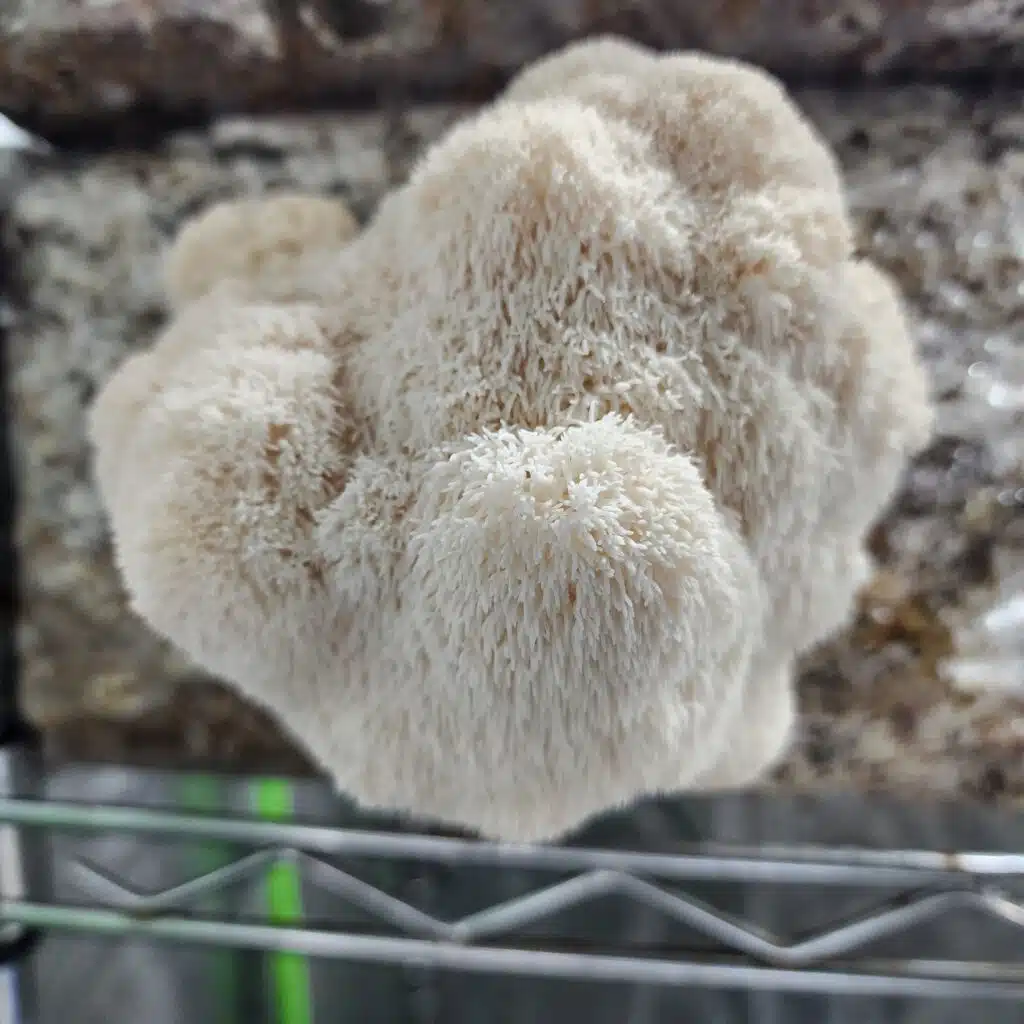
Knowing when to harvest lion’s mane matters as much as growing it. It usually reaches harvest 7–14 days after it starts growing from the opening. Harvest when the spines are about 1/4 to 1/2 inch long and the mushroom is still white and firm.
Do not wait for it to get bigger. As it matures, the fruit yellows, the spines lengthen and begin dropping spores, and both texture and flavor decline. Cut at the base with a clean knife, close to the block surface.
How long does lion’s mane take to grow?
From inoculating grain to first harvest, expect about 6–8 weeks.
| Stage | Typical time |
|---|---|
| Grain colonization | 10–14 days |
| Sawdust colonization | 2–3 weeks |
| First growth after opening the bag | 3–7 days |
| Growth to harvest | 7–14 days |
| Total | About 6–8 weeks |
Temperature, strain and spawn rate all shift these numbers. Cooler incubation slows things down, and higher spawn rates speed them up.
Getting a second flush
After harvest, let the block rest for 1–2 weeks in fruiting conditions. Many blocks produce a second, and sometimes a third, flush from the same opening, though later flushes are usually smaller. Soaking the block in cold water for several hours can help it rehydrate before the next flush.
Troubleshooting common problems
- Long, stringy spines or a coral-like shape: CO₂ is too high. Increase fresh air exchange.
- Yellow, pink or brown tones: usually a sign the mushroom is past its prime. Dry air, strong light or cold can also shift its color. Harvest earlier and check your humidity.
- Dry, brown patches on the fruit: humidity is too low, or air is blowing directly on the mushroom.
- The block never pins: it may need an opening cut, or a move to cooler fruiting conditions with more fresh air.
- Green patches in the bag: likely Trichoderma contamination. Remove the block from your grow space before it spreads.
Lion’s mane growing FAQ
How long does lion’s mane take to grow?
About 6–8 weeks from inoculating grain to the first harvest, with roughly 7–14 days from first visible growth to harvest.
When is lion’s mane ready to harvest?
When the spines are 1/4 to 1/2 inch long and the mushroom is still white and firm, before it starts to yellow.
What wood does lion’s mane grow on?
Hardwoods. In the wild it favors oak, beech, maple and walnut. For cultivation, Master’s Mix gives it a hardwood base plus the soy hull nutrition it needs.
Does lion’s mane need light to grow?
It needs some light to fruit normally, but not much. Indirect room light or a low-wattage LED for about 12 hours a day is enough. Mushrooms do not use light for energy the way plants do; it acts as a cue for fruiting.
Can you grow lion’s mane on CVG or coco coir?
Not well. Lion’s mane is a wood decomposer and needs a hardwood-based substrate such as Master’s Mix to produce a good crop.
Start your first lion’s mane grow
Our Lion’s Mane Liquid Culture is prepared in our lab and is a clean starting point for your first grow. If you prefer to work from agar, browse our culture media and additives, or make your own liquid culture with our Liquid Culture Premix.